Argentinian Alfajores Recipe
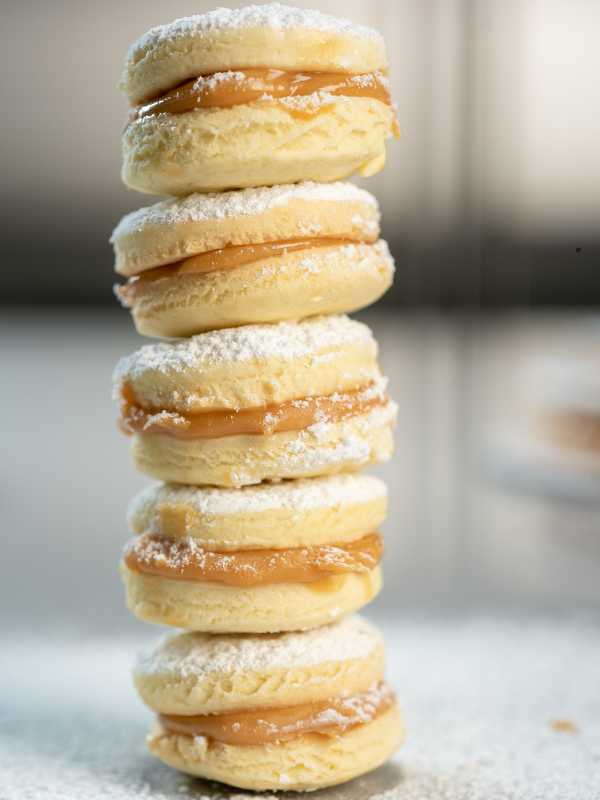
Alfajores are traditional Argentinian sandwich cookies which consist of a dulce de leche filling and powedered sugar coating. The cookie is cornstarch based and is baked lightly to set firm. Dulce de leche is piped onto one cookie and covered with another. Its then rolled in the powdered sugar.
Classic alfajores cookies are vanilla flavored or plain but some variations are coated in melted chocolate. Nontraditional fillings are jam, fruit filled or chocolate mousse. They may also be rolled in powdered chocolate or fine coconut flakes.
Besides these variations, many snack companies sell a triple alfajores which consists of three layers and may consist of a combination of fillings and flavors in a single cookie.
Origin and Cultural Significance
Alfajores originated from the Middle East. In fact, the name comes from alaju, the Arabic word meaning filled.
The original filling would have been made of dried fruit or nuts and once brought to Spain by Muslims, adapted the powdered sugar coating. Later when the Spaniards brought them to South America, the filling was replaced with dulce de leche.

Argentinian Alfajores Recipe
Alfajores are traditional Argentinian sandwich cookies which consist of a dulce de leche filling and powdered sugar coating.
Ingredients
- Corn starch - 2 ½ cups
- All-purpose flour - 1 ½ cup
- Baking soda - ½ tsp
- Baking powder - 2 tsp
- Powdered sugar (sifted) - 1 ¼ cup
- Butter (unsalted, softened) - 7 oz
- Egg yolks (large, room temperature) - 3
- Vanilla extract - 1 tsp
- Lemon zest – 1 lemon
- Dulce de leche - as needed
Instructions
- Sift all the dry ingredients except the powdered sugar together into a bowl, set aside.
- In another bowl, mix powdered sugar and butter until creamy using a handheld whisk.
- Add egg yolks one at a time, mixing well to combine after each yolk.
- Add the vanilla extract, lemon zest and mix to combine.
- Add the bowl of dry ingredients in 3 additions, mixing just enough after each addition. Don't over mix.
- After the 3rd addition, pour everything onto the working surface.
- Start folding the mixture onto itself and gently push into a ball. Do not knead.
- Wrap with cling film and chill in the fridge for 30 minutes or until manageable.
- Put ⅓ of dough on a cling film and cover it with another layer of film.
- Gently roll it into 8-10mm thickness. If the dough breaks, just gently push it back together.
- Chill in the fridge for 10 minutes while you continue rolling the rest.
- Take 1 rolled dough from the fridge and place it on the working surface.
- Remove the top cling film.
- Cut out 1.7 inch circles using a floured cutter.
- Place on parchment paper on a baking tray. Place in the fridge if not baking them immediately.
- Bake at 360 F in a preheated oven on the middle rack for 10-12 minutes or until fully cooked without allowing the cookie to brown.
- Cool completely before using.
- Pipe dulce de leche on the bottom side of a cookie, more or less the same thickness of the cookie itself.
- Take another cookie and place it on top and lightly press.
- Roll in desiccated coconut.