Greek Saganaki Recipe (Crispy Fried Cheese)
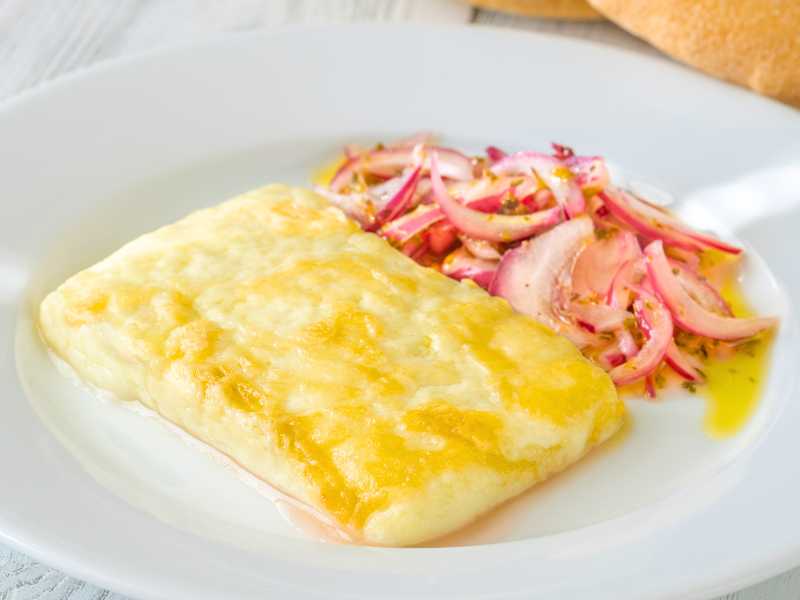
Saganaki is a traditional Greek appetiser made by frying a thick slice of cheese until it develops a golden, crispy crust and a soft, warm centre. The cheese is lightly coated in flour, pan-fried in olive oil and served immediately with a squeeze of fresh lemon juice.
This Greek saganaki recipe takes around 15 minutes to prepare and requires just a handful of ingredients. The secret to getting it right is choosing a firm cheese that holds its shape when heated, cutting it thickly enough and making sure the oil is hot before frying.

What is saganaki?
Saganaki is a popular Greek meze, or small dish, commonly served in tavernas as part of a selection of appetisers. Traditional cheese saganaki consists of a thick piece of cheese coated in flour and shallow-fried until the outside turns golden brown.
The name comes from the sagani, a small, traditionally two-handled frying pan used in Greek cooking. Although the word can refer to several dishes prepared in this style of pan, saganaki on its own usually refers to fried cheese.
Other popular variations include garides saganaki, a dish of prawns cooked in a tomato-based sauce, often with feta cheese.
Cheese saganaki is typically served straight from the pan, accompanied by lemon wedges and sometimes crusty bread. It is a simple dish, but the contrast between the crisp exterior and rich, softened cheese makes it particularly satisfying.
What cheese is best for saganaki?
The most important decision when preparing saganaki is which cheese to use. You need a firm cheese that can withstand high heat long enough to form a crust without immediately melting and spreading across the pan.
Several traditional Greek cheeses work particularly well.
Kefalotyri
Kefalotyri is a hard, salty Greek cheese traditionally made using sheep’s milk, goat’s milk or a combination of the two.
It has a strong, savoury flavour and a firm texture that makes it particularly well suited to frying. Its saltiness also means there is generally no need to add extra seasoning.
Kefalotyri is a good choice if you prefer a pronounced cheese flavour and a crisp exterior.
Kefalograviera
Kefalograviera is another excellent option. It is a firm Greek cheese with characteristics of both kefalotyri and graviera.
It has a slightly milder flavour than kefalotyri while retaining enough structure to hold together when fried.
Kefalograviera is particularly good for saganaki because it develops a golden crust while the centre becomes warm and tender.
Graviera
Graviera is one of the most popular cheeses for preparing saganaki.
It is a firm Greek cheese with a rich, slightly sweet and nutty flavour. Depending on the variety and age, it can become pleasantly soft when heated without immediately losing its shape.
Graviera is an excellent choice for anyone who wants a milder, less salty version of saganaki.
Can you use halloumi instead?
Yes. Halloumi is a practical substitute if you cannot find traditional Greek saganaki cheeses.
Originally associated with Cyprus, halloumi is particularly suitable for frying and grilling because it retains its shape at high temperatures.
However, the finished texture will be different. Halloumi tends to remain firmer and chewier, whereas graviera or kefalograviera can develop a softer, more yielding centre.
For a more traditional Greek cheese saganaki, choose graviera, kefalograviera or kefalotyri wherever possible.
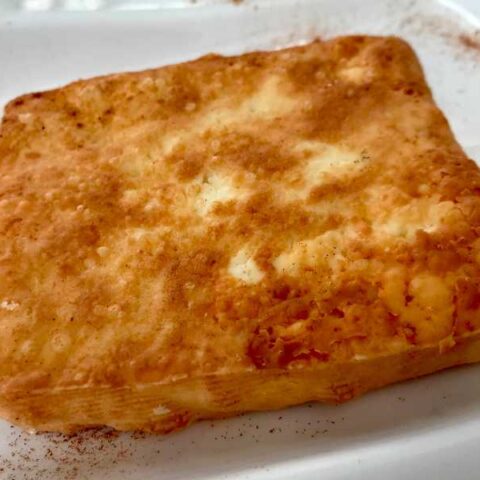
Greek Saganaki Recipe
Saganaki is a traditional Greek dish of pan seared cheese. A large piece of cheese is coated in a fine layer of flour and pan fried in olive oil until the outsides of the cheese form a crust while the inside is soft and melted.
Ingredients
- Graviera, kefalograviera or kefalotyri cheese - 200g
- Plain flour - 30g, for coating
- Olive oil - 1–2 tbsp, for frying
- Lemon - ½, cut into wedges
- Cold water - a small amount, for coating the cheese
Instructions
- Prepare the cheese. Cut the cheese into one or two thick rectangular pieces, approximately 1–1.5cm thick. Avoid cutting it too thinly, as thinner pieces are more likely to lose their shape when heated.
- Coat the cheese. Briefly dip each piece into cold water, allowing any excess to drip off. Place the flour on a plate and coat the damp cheese on all sides, shaking off any excess flour. You only need a light, even coating.
- Heat the oil. Add the olive oil to a small, heavy-bottomed frying pan over medium-high heat. Allow the oil to become hot, but not smoking, before adding the cheese.
- Fry the first side. Carefully place the cheese in the pan and cook undisturbed for approximately 1–3 minutes, until the underside develops a deep golden crust. The exact cooking time will depend on the thickness of the cheese and the temperature of the pan.
- Turn and finish cooking. Carefully flip the cheese using a spatula and fry the other side until equally golden. The exterior should be crisp, while the inside should be warm and softened. If your pan is small, cook the pieces separately.

- Serve immediately. Transfer the saganaki to a plate and squeeze fresh lemon juice over the top just before eating. Serve while hot for the best texture.
Nutrition Information:
Yield: 2 Serving Size: 1Amount Per Serving: Calories: 393Total Fat: 26gSaturated Fat: 11gTrans Fat: 1gUnsaturated Fat: 12gCholesterol: 54mgSodium: 360mgCarbohydrates: 25gFiber: 1gSugar: 1gProtein: 16g
Nutrition is provided and calculated by Nutritionix. It is for general information purposes and is only a rough estimation.
Tips for making perfect saganaki
Although saganaki is straightforward to prepare, a few small details can make a substantial difference to the result.
Choose a cheese that holds its shape
Not all cheeses are suitable for saganaki. Soft, high-moisture cheeses may melt too quickly, making it difficult to develop a proper crust.
Firm Greek cheeses such as kefalotyri, kefalograviera and graviera are better suited to the traditional preparation.
Don’t cut the cheese too thinly
Aim for slices approximately 1–1.5cm thick.
Thicker pieces allow the outside to become golden before the entire piece of cheese softens. Very thin slices can melt or become excessively soft before the crust has formed.
Use a light coating of flour
The flour helps create the distinctive golden crust and provides a little protection against the heat of the pan.
Briefly dampening the cheese before coating it helps the flour adhere.
However, avoid leaving a thick layer of flour on the surface. Shake off the excess so the finished saganaki has a thin, crisp coating rather than a heavy, doughy exterior.
Make sure the oil is hot
If the oil is not hot enough, the cheese may soften before the exterior has had time to brown.
Allow the pan and oil to heat properly before adding the cheese. You should hear a gentle sizzle when it touches the pan.
Avoid excessively high heat, which can burn the flour before the cheese has warmed through.
Don’t move the cheese too soon
Allow the underside to develop a crust before attempting to turn it.
Moving the cheese repeatedly can damage the coating or cause the softened cheese to break apart.
A flat spatula is useful for turning it carefully in one movement.
Serve immediately
Saganaki is best eaten directly after cooking.
As the cheese cools, the texture can become firmer and the crispy coating gradually loses its crunch.
Prepare the rest of your meal in advance so the saganaki can be served as soon as it leaves the pan.
What to serve with saganaki
Saganaki is traditionally served as a meze, making it ideal for sharing alongside other Greek dishes.
The cheese is rich and savoury, so fresh vegetables, sharp flavours and simple accompaniments work particularly well.
Popular options include:
- Warm pitta or crusty bread: Ideal for accompanying the cheese and soaking up any remaining olive oil.
- Greek salad: Tomatoes, cucumber, olives and red onion provide a refreshing contrast to the rich fried cheese.
- Tzatziki: A cooling yoghurt and cucumber dip complements the salty cheese.
- Dolmades: Stuffed vine leaves make another excellent addition to a Greek meze selection.
- Grilled vegetables: Courgettes, aubergines and peppers add variety without making the meal too heavy.
- Olives: A small bowl of Greek olives is a simple, traditional accompaniment.
For a larger Greek-inspired meal, saganaki can also be served as a starter before dishes such as Greek gyros.
You can discover more traditional dishes in our guide to Greek food.
Saganaki variations
The traditional version needs little more than cheese, flour, olive oil and lemon, but there are several ways to adapt it.
Saganaki with honey
For a sweet and savoury variation, drizzle a little honey over the freshly cooked cheese.
The sweetness contrasts particularly well with salty cheeses such as kefalotyri. A small sprinkling of thyme or sesame seeds can also complement the flavour.
Saganaki with oregano
A pinch of dried oregano added just before serving gives the cheese a fragrant Mediterranean flavour.
Keep the seasoning relatively subtle so it doesn’t overpower the cheese.
Halloumi saganaki
Halloumi can be used in place of graviera or kefalotyri when traditional Greek cheeses are difficult to find.
Prepare it using the same basic method, adjusting the cooking time as necessary. The finished cheese will generally be firmer and more elastic than traditional saganaki.
The origins of saganaki
Saganaki has its roots in Greek cooking, where cheese has long been an important ingredient and fried-cheese dishes are a familiar part of the country’s meze tradition.
The dish takes its name from the small frying pan used to prepare it, rather than from a particular type of cheese.
Different regions and individual tavernas use different cheeses, depending on local dairy traditions and availability.
One particularly interesting part of saganaki’s history concerns the flaming version commonly associated with Greek restaurants in the United States.
Why is saganaki sometimes set on fire?
In some Greek-American restaurants, saganaki is served flambéed with alcohol, often accompanied by a theatrical shout of “Opa!”
This preparation became famous in Chicago during the 1960s. The Parthenon restaurant, which opened in 1968, is widely credited with popularising the practice of setting fried cheese alight at the table.
However, this theatrical presentation is a Greek-American adaptation rather than an essential part of traditional Greek saganaki.
In Greece, cheese saganaki is generally served without flames, allowing the flavour of the cheese and its crispy coating to take centre stage.
Can you prepare saganaki in advance?
Saganaki is best cooked immediately before serving, but you can complete some of the preparation ahead of time.
The cheese can be cut into portions and kept covered in the refrigerator until you’re ready to cook.
For the best results, wait until just before frying to dip it in water and coat it with flour. This prevents the coating from becoming excessively damp.
Cooked saganaki is less suitable for preparing in advance because the cheese firms up as it cools and the coating loses its crispness.
If you have leftovers, refrigerate them promptly and reheat thoroughly. However, the texture is unlikely to be as good as when freshly prepared.
FAQs
Can you make saganaki with feta cheese?
Feta can be fried, but it behaves differently from firmer cheeses such as graviera or kefalotyri.
Because feta is softer and more crumbly, it is usually better suited to a different preparation, such as coating it more substantially or wrapping it in filo pastry before cooking.
For classic cheese saganaki with a thin flour coating, a firm Greek cheese is the better choice.
Why does my saganaki melt in the pan?
Saganaki may lose its shape if the cheese is too soft, the slices are too thin or the pan isn’t hot enough to develop a crust quickly.
Choose a firm cheese suitable for frying, cut it into thick pieces and ensure the oil is hot before adding it to the pan.
Avoid moving the cheese repeatedly while it cooks.
Can you make saganaki without flour?
Yes, certain cheeses can be pan-fried without flour, particularly halloumi, which naturally holds its shape when heated.
However, the flour coating is a characteristic part of traditional cheese saganaki, helping create the crisp, golden exterior.
Leaving it out will produce a different texture.
Can you make gluten-free saganaki?
Yes. You can replace the plain wheat flour with a suitable gluten-free flour blend.
Choose a flour that produces a light coating and shake off any excess before frying.
If preparing the dish for someone with coeliac disease, ensure the cheese, flour and other ingredients are suitable and avoid cross-contamination.
Do you need a special saganaki pan?
No. Although saganaki traditionally takes its name from the small frying pan used to prepare it, you can make the dish in an ordinary frying pan.
A small, heavy-bottomed pan is ideal because it distributes heat evenly and makes it easier to control the cooking.
A cast-iron skillet or good-quality non-stick frying pan can both work well.
Is saganaki the same as fried halloumi?
Not exactly. Both involve cooking cheese in a hot pan, but traditional Greek saganaki usually uses cheeses such as kefalotyri, kefalograviera or graviera, often with a light flour coating.
Halloumi is a Cypriot cheese that is commonly grilled or fried without flour.
Halloumi can be used as an alternative in saganaki, but its firmer, chewier texture produces a different result.